Thursday, November 21, 2013

Some pictures, to cleanse the palate.

As promised, here are some more pictures. Most of these are part of my "Domestic Monsters" series.

This fella just wants to go trick or treating with you. He's harmless, really.


 Here's a dapper skelly-tun having a shave before All Hallows' Eve.

 Here's a Gorgon (Medusa head) just because Tony Murphy asked me if I'd ever drawn one. Now I have.

And here's the Minnesota Vikings' logo. I drew this one one sheet of paper, colored it in with marker and colored pencil, then cut the image out with an X-acto knife, and glued it to the blue background. (It was the closest thing I had to Viking purple.) For my nephew, who's a die-hard Vikings fan.

A few pictures and a couple of words.

Okay, so I've been writing more, and drawing a bit, but I want to keep that trend going, so I've committed to updating this blog several times a month. It's good for me and (if you're reading this) hopefully a pleasant diversion for you. So, first with the words. This is a reflection I wrote this weekend. While I'm planning to continue posting nonfiction reflections, I'm also working on a novel, and may start posting sections of that, or at least some of my short stories. I honestly welcome feedback, even if it's "hey buddy, don't quit your day job." But I'll keep posting drawings, as they come. Here goes:

I am weak. 
This is not a crisis of self-confidence, you understand. It’s a recognition of a basic fact. By myself, I am able to accomplish startlingly little. I do have a certain amount of control over my reactions to my circumstances, and control over many of the choices that I make, but in many more ways, I’m weak. There are so many things that I dream of doing: of being able to change my height and flying and being a perfect husband and son and brother and helping other people conquer their social anxieties; but I can’t. I can’t change unless I’m willing to admit I need to change, and that I need help to realize that change.

Is weakness the same as complete powerlessness? No. Can I be a good man as a short man? Yes. Can I figure out my weaknesses as a husband by listening carefully to my wife and asking for her help to become better over time? Yes. Can I make resolutions to start good habits in my life? Yes.

Can I learn to fly like a hawk? No. Can I feed all the hungry people in the world? No.

It may seem like I’m being intentionally flippant, but there are plenty of things that I can’t do, that I want to do, and part of me feels like a failure when I realize how little I can really change. But then there are plenty of things I need to do that I’m capable of; but I need help to accomplish them, and humility to recognize when I’m heading in the wrong direction.

Being a religious person, I have always held the conviction that I am dependent on a higher, universal, personal, caring consciousness. (I’m intentionally avoiding precise religious terminology. I’m doing that because I’ve met lots of people, many of them very dear to me, who have found only hostility and judgment in the halls of religion, and yet many of those same people are striving to find a place for genuine, life-giving spirituality in their lives. I count it a privilege to have shared any part of their journey and am honored to share mine with them, and so I’m hoping that less charged language will speak to the commonality of both the religious and those who are taking a more individualized path to truth. I’m trusting in the wisdom of Gandalf, that not all those who wander are lost.) So, I’ve always believed in this wise consciousness that knows me and cares for me. And yet, I have often found it difficult to sit down and listen to this consciousness, and most of the time, I’ve simply been too busy to even try. But lately I’ve been trying to assess my life, to figure out what’s working and what’s holding me back, and how I can be a more effective person. For a long time I’ve been encountering anxiety and frustration, feeling like parts of my life were totally out of my control, and I've felt disconnected from some things that were very important to me. With the help of some very good friends, I’m coming to see that, even though I’ve been telling myself that I’m flawed and need help and encouragement to grow, I’ve been living “as if” I were strong and in control. I said that I believed in this power greater than myself, but I seldom checked in with that being. So I asked myself: if I really believed myself to be weak, how would my life be different? 

The first thing that came to mind was, if I really believed that I needed help, and I knew where to turn to get that help, I’d make sure I spent some time, each day, turning to that source. Part of that conversation, then, is, going to be recognizing my weaknesses and frustrations, and maybe some time recognizing my accomplishments and things I’m grateful for. But part of that time will also need to be spent listening. 

Listening is a hard thing to do, I’m finding. But, like anything, it will come with practice, and it may come slowly. So I’m going to be patient with myself. Sometimes, I imagine, listening is going to involve reading helpful books; sometimes it will involve talking to close friends and family; sometimes it involves going for a walk and getting a breath of fresh air, watching a sunset, or really relishing a nice dinner. But simply engaging in those activities isn’t enough for me; if I’m going to listen, I need to be quiet.  And that’s not easy, especially when we live such fast-paced, noise-filled lives. But I’m resolving to take 5 minutes, each day, and sit quietly, and put myself in the presence of that being who cares for me, and has a deeper understanding of the world around me, and wants to develop a supportive and life-giving relationship with me. 5 minutes away from my phone, away from exercise routines and calendars, away from coffee and books, and giving myself the gift of silence, shared with a friend. A friend who wants to help me. A friend who offers me strength when I’m willing to accept it. 
I’ve known this for a long time. But today, I’m trying to live as if it were true. 

Friday, August 16, 2013

Okay, so I'm setting the drawing aside for a while and focusing on the writing. I haven't really edited this one, so keep that in mind. 


This is an interesting day and an interesting set of readings. For those non-Catholics who might be reading this, this is a day when we’re all (Catholics, that is) supposed to go to church; it’s a special day when we commemorate Mary, the mother of Jesus, being taken up into heaven, body and soul. Kind of an unusual way to get there; but then, we are told, she was something of an unusual woman.


Take today’s reading from the gospel of Luke, chapter 1, verses 39 to 56. Even if you’re allergic to religion on every scale, this is just an interesting story, theology and dogmas aside. Here you have this young girl, by most modern accounts around 15, and she suddenly gets pregnant in circumstances which could be very difficult for a young, as yet unmarried girl of that time. But she’s happy because she has this spiritual insight about the baby she’s carrying. But, let’s stick with the human side of this story. She’s young, she’s engaged but not yet married, and she’s newly pregnant. At the same time that she hears she’s expecting, she also finds out that her cousin, who is well beyond child-bearing years, has also got a bun in the oven. Now, I suppose that at this point I ought to give my impression of pregnancy. I’ll never forget flying out to visit my sister some 11 or 12 years ago, she must have been 6 or 7 months pregnant with her 2nd son, and in spite of carrying a little person around inside of her she showed up at the airport to pick me up, all smiles, all made up and looking so composed. And I was taken aback; I couldn’t help thinking, if I were pregnant, I’d crawl up in bed as soon as I found out and would just call out for ice cream. I wouldn’t set foot outside the house for 9 months, and maybe even beyond the birth, just to take a few months to recover.


So here’s this young thing, just finds out she’s pregnant, and then hears that her old cousin is also pregnant. I would think that it would have been great for Mary to write a letter or find out if anyone in her town was going to her cousin’s town and maybe have them pass along her congratulations. But that’s not enough for Mary. She hops on the back of a donkey and heads out into the dusty byways of first century Palestine to visit her cousin, Elizabeth. That astounds me; just the human devotion of hopping on the back of a donkey for a couple of days with a baby on the way, just to visit your cousin.

Now, the scene which unfolds when Mary gets to Elizabeth’s house is sweet, although I think it could come off as a bit cloying to some. So let me unwrap it a bit. Mary gets to the house, she’s doubtless tired, maybe a little nauseous from carrying a baby on a donkey, and she walks inside and calls out for Elizabeth; Elizabeth, hearing Mary’s voice, feels her own baby jump in her womb. Now, for a long time I thought that was some miraculous thing, that at the sound of Mary’s voice the still-incubating John would jump up. Well, as I thought about it tonight it occurred to me that babies, so I am told, jump around all the time; they kick, too. So Elizabeth calls out the famous line, “Blessed are you among women, and blessed is the fruit of your womb.” After another line or two from Elizabeth, Mary then launches into her own soliloquy, a famous poem known as the Magnificat, from the Latin version of the first word in her monologue. I have heard that her response is likely a popular poem or song from that time period; I like that, because it just makes it a bit more human to me to think that Mary was quoting, rather than thinking she just walked around making gorgeous speeches. So, here’s my interpretation. You’ve got two women, relatives; and clearly, there’s a lot of affection between them. And they’ve both lived their entire lives in a very conservative religious context, in a society where science hasn’t really been introduced. So, in order to make sense of new experiences, they couch things in religious and miraculous terms. And both of these women are experiencing their first pregnancies, each in rather surprising circumstances. Elizabeth, because she’s very old, and Mary, because she’s very young. And they want to get together, to support each other, to lean on each other, probably to compare notes and laugh and cry together.

So why am I bringing this up? Well, it struck me in a new way tonight; it struck me because I was listening to it through the lense of the second reading, where we are told that, at the end of all things, Jesus will have “destroyed every sovereignty and every authority and power. For he must reign until he has put all his enemies under his feet. The last enemy to be destroyed is death, for ‘he subjected everything under his feet.’’ We Christians talk a lot about eternal life, and the life to come, and all this about life. And we are told that Christ came that we might have life, and have it to the full. But what does that mean? I’d always imagined that when I die I’d get a robe and a harp and all that, and I’d go to heaven and would sit around eating ice cream all day and never getting fat. But is that what it means to have life to the full?

I’ve been having a lot of intense conversations with some of my friends lately, talking about bad habits and patterns of selfish thinking, and so I’ve been especially conscious of egotistical thoughts lately. And I’m realizing that somehow, in the midst of trying to be a good husband and brother and son and uncle and coworker and friend, I’ve got to strike a balance between serving others and taking care of myself. For much of my life, I thought that the way to do that was to neglect myself and try to save others. But all that did was make me unhappy and useless because no matter how hard I tried, people just didn’t want to accept my brand of saving, and then I’d get cranky and pout because I had been neglecting my own needs. And I’m coming to realize that being focused on others is very different from saving them, and that the first step to being an effective servant is identifying my own needs and meeting them, but taking care to distinguish wants from needs. I’m reminded of a line from the novel Middlemarch: “And certainly, the mistakes that we [...] mortals make when we have our own way might fairly raise some wonder that we are so fond of it.” And that’s what I’m coming to realize; when I try to plan my own time, my own life, on my own, then I tend to make a big mess of things. And so, when I’d found out my cousin was also pregnant, I’d have said, “that’s nice,” and kept on about my business. And while I would have been comfortable at home, I would have been missing out on a chance to experience something with a loved one. And so I’m learning not to idolize my comfort; because if I’m to have any hope of eternal life, or even a full life, then I must lean on the hope that Jesus brought. And if I’m to hope that he will offer me the promise of eternal life, well, as it says above, he must “destroy every sovereignty and every authority and power.” And that means, really, that I have to let my own power, my desire for control, be destroyed. I have to recognize that I need other people, and quit being so doggedly self-reliant. I need to be willing to change patterns of behavior and give up comforts, so long as what’s being offered in return is real growth. And I’m finding that, for me, the ultimate sign of growth is the increased ability to care for other people.

Thursday, January 19, 2012

Tango dancers

A coworker asked me to draw her something for her cubicle, and for some reason I knew it had to be tango dancers. So here they are.

Friday, September 2, 2011

New stuff

 Some character from the pages of California history. A banker, I think. Just loved that self-assured grin.
 A famous singer, done in the style of Mort Drucker.
 First attempt at the unforgettable Bride of Frankenstein.
 The Golem, a character from Jewish folklore. German filmmaker Paul Wegener made a wonderful movie about the most famous Golem story, simply called The Golem.
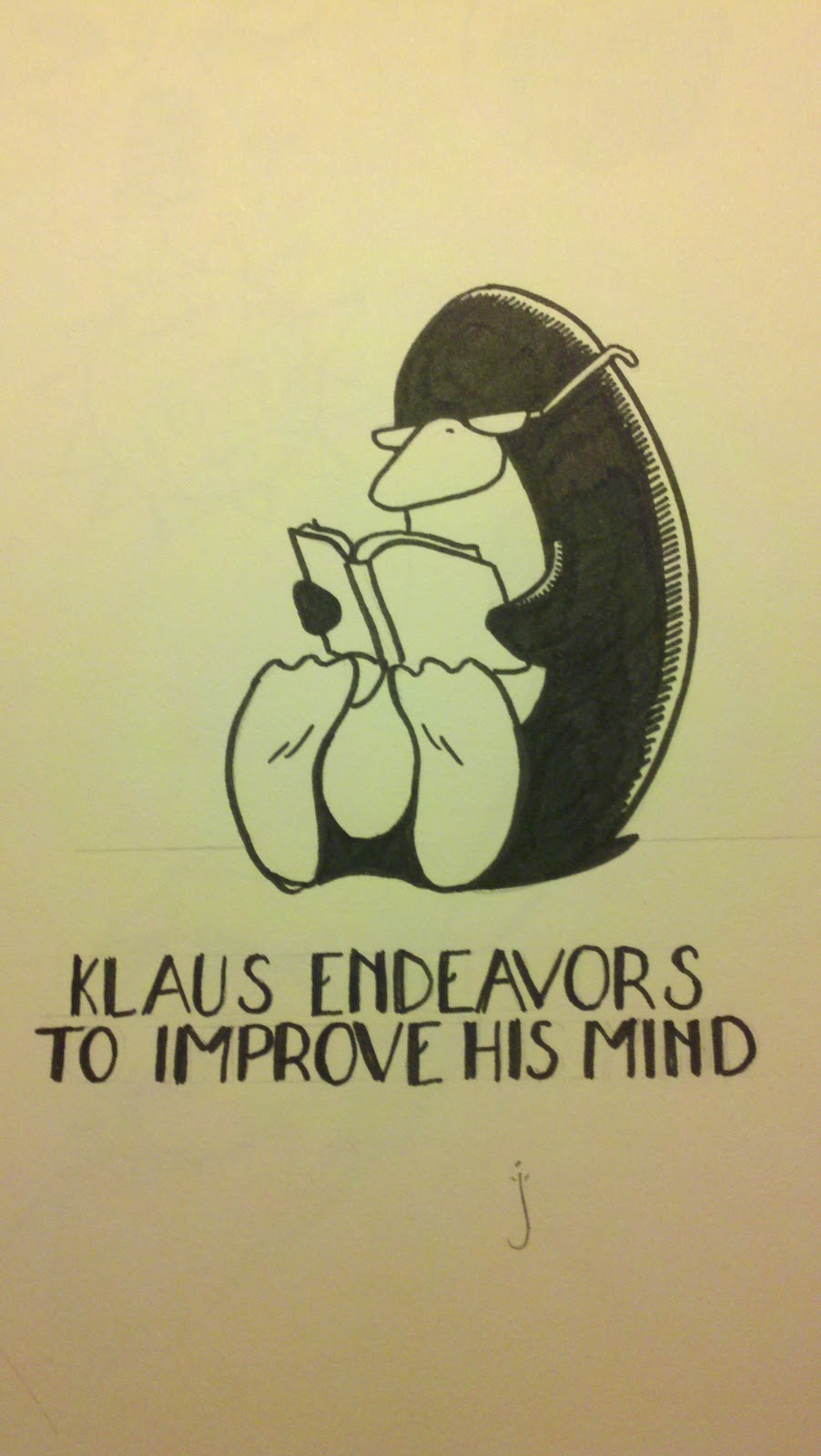
 Humble Klaus, one of my characters, catching up on some reading.
 The Leshy, spirit of the Russian forest, in his wolf-skin coat.
 Mr. Pfefferneusse, a troublesome bureaucrat.
 A raven standing in snow.
 A hep cat jiving on the bongos.
 The Leshy again, looking goofy.
 A Transylvanian innkeeper as imagined by Hollywood. From Tod Browning's Dracula.
The Tsarevich Alexei, son of Nicholas II, the last czar of Russia.

Sunday, June 12, 2011

Assorted scratchings

 Here's...a baby!
 Here's an old crone...best stay away from this one. She looks crafty.
 I like to make up characters and settings, and I created a little tavern called the Foggy Porthole, the sort of place 19th century sailors might frequent. I seem to recall it being on the Black Sea.
 This is one of the toughs who walked the wild streets of 19th century New York City. Not fictitious; I found this picture in my illustrated copy of the book Gangs of New York, which served (loosely) as the basis for the Martin Scorcese film.
 This is an odd little egg-man I dreamed up. Here he is, contemplating existence.
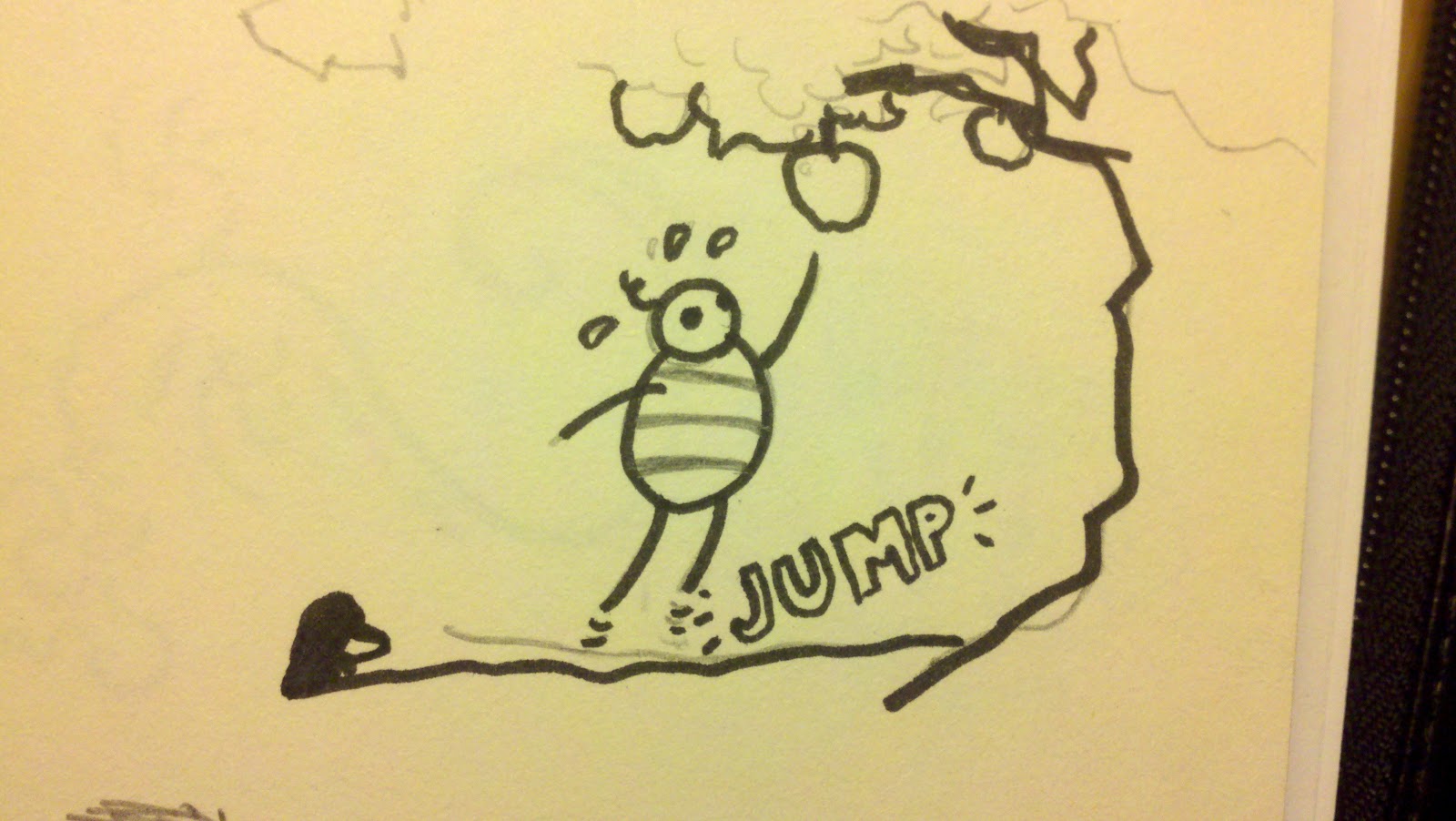
 Here he is again, striving for an apple.
 Here he is, looking into the sky on a rather Seussian pillar. His cousins dot the skyline behind him.
 I don't know why, but gorillas are extraordinarily fun to draw. Although I do tend to anthropomorhize a bit, I admit.
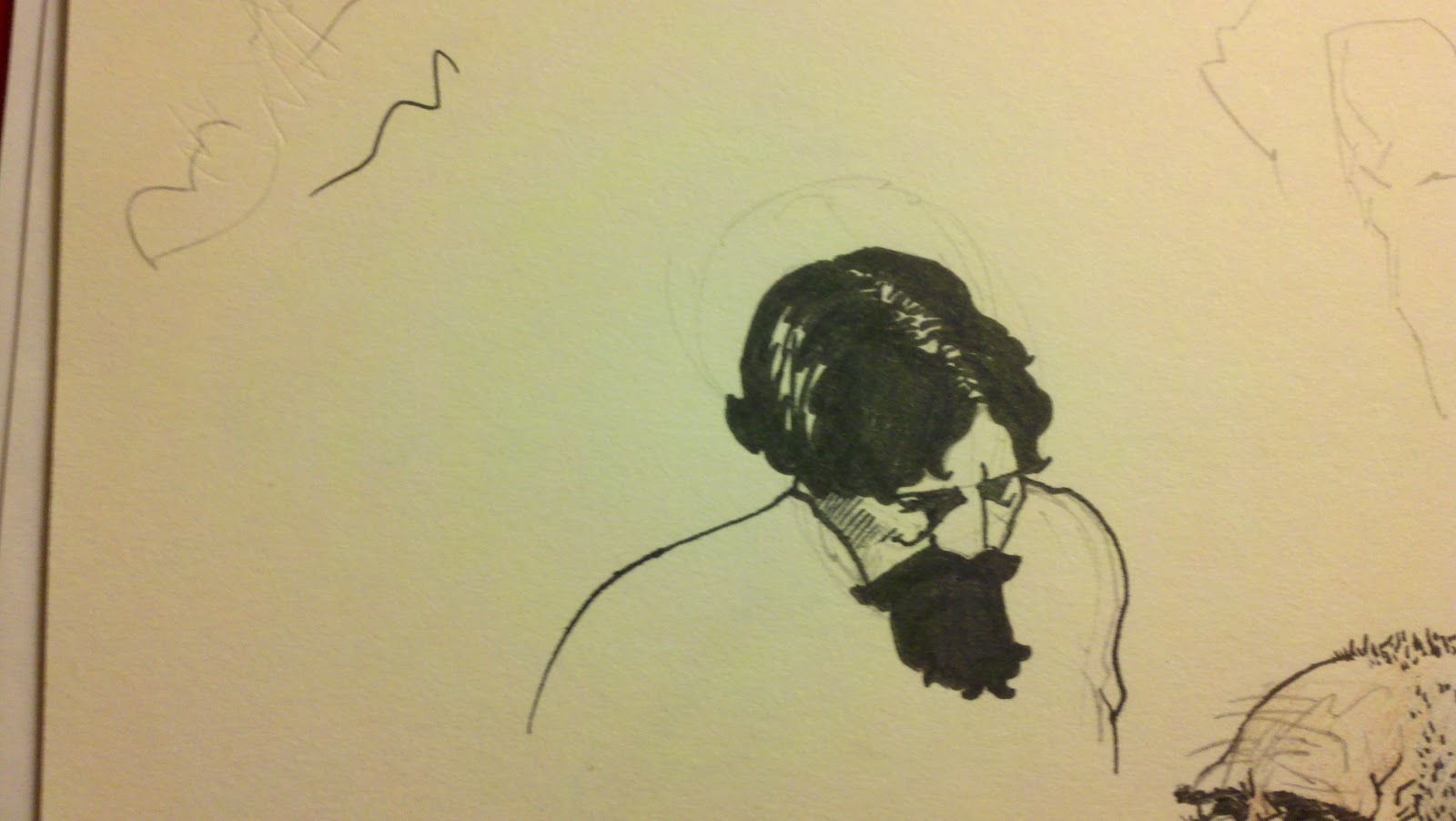
 Here's a rather apathetic looking fellow. Some of the detail didn't photograph well.
 Here is an expressionist rendering of one of my favorite historical characters, Grigory Efimovich Rasputin. He combines so many of my interests: the late 19th century, Russia, claims of control over the limits of human ability. If you're at all interested, I highly recommend the book Rasputin, the Holy Devil by Rene Fulop-Miller.
 Here is a pair of brothers I devised in imitation of the great Edward Gorey.
 Remember what I said about gorillas?
 Here's Jackson Pollock at work. I made no attempt to recreate his art; this is only a crude representation.
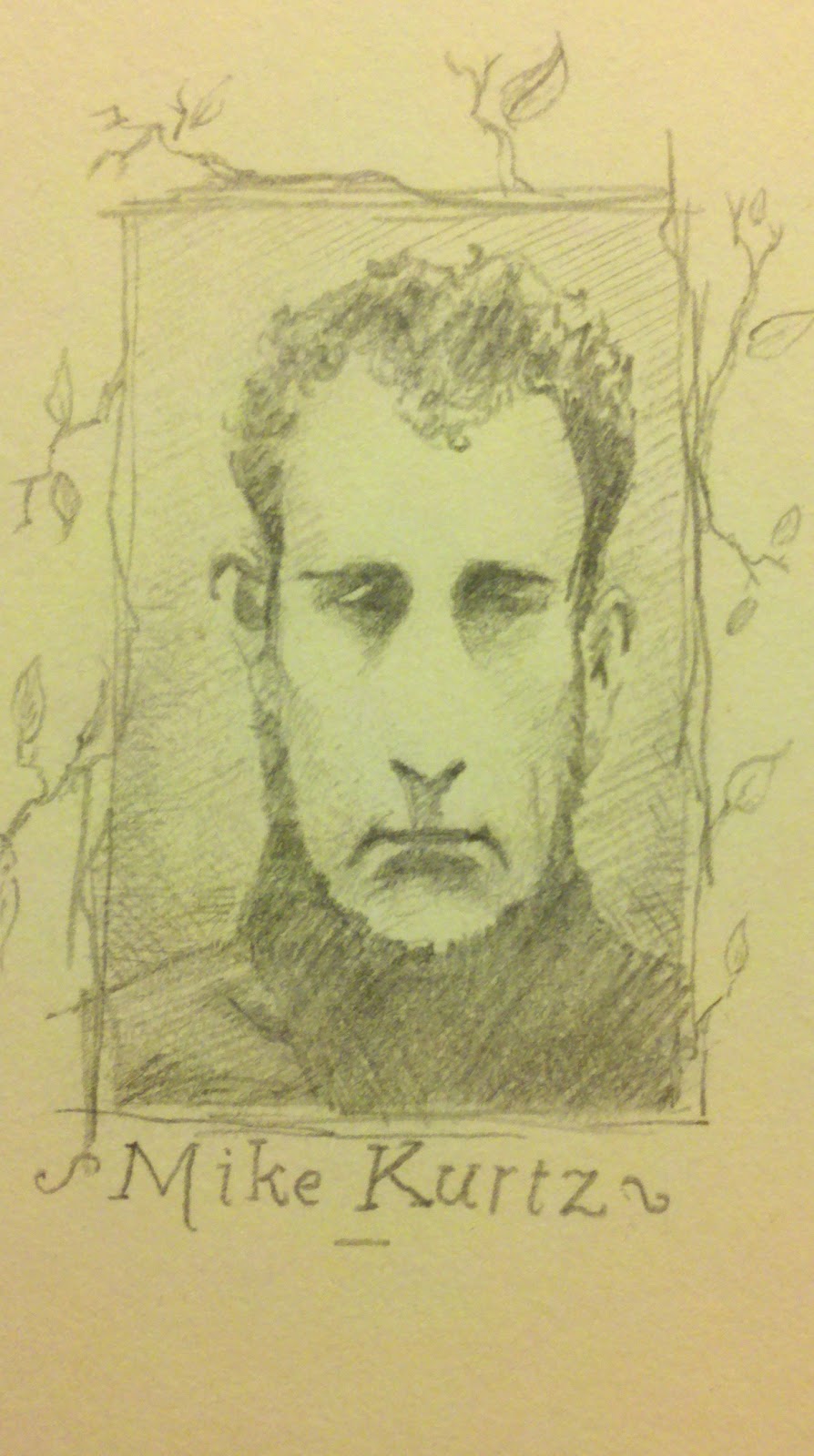
 Mike Kurtz, another hood from the pages of Gangs of New York.
 A drawing taken from a poster at work. I drew this in about 10 minutes, longer than I usually take for a drawing; it comes from New Zealand, I think.
 You can't learn about Rasputin without getting sucked into the tragic and compelling world of Nicholas II, Russia's last czar. This is one of my favorite drawings of one of my favorite characters.
 Here's some old man, likely an inhabitant of 19th century Nantucket. Perhaps inspired by Father Mapple from Moby Dick. If, by the way, you haven't read Moby Dick, then you're just biding time.
 Speaking of Melville's masterpiece, here's Queequeg; one of literature's most captivating figures. It's possible to impose all sorts of "noble savage" deconstruction of the naivete of the Victorian white male ideology on this character, but at the end of it all, Queequeg still stands, severe and serene, and utterly believable.
 Well, just because I didn't major in English doesn't mean I can't be working on a novel in my spare time. Here's a study of the main character (English majors call them "protagonists"), named Viktor. And here's the surprise: he comes from the 19th century, and he's Russian.
 Sometimes you draw whatever you see. I had a DVD of Tracey Morgan's "Best of SNL" moments at hand, and this was the result.
Czar Alexander III, father of Nicholas II.

A quick sketch

Here's one I did while on break at work, taken from a poster for vacations to New Zealand.